Summary
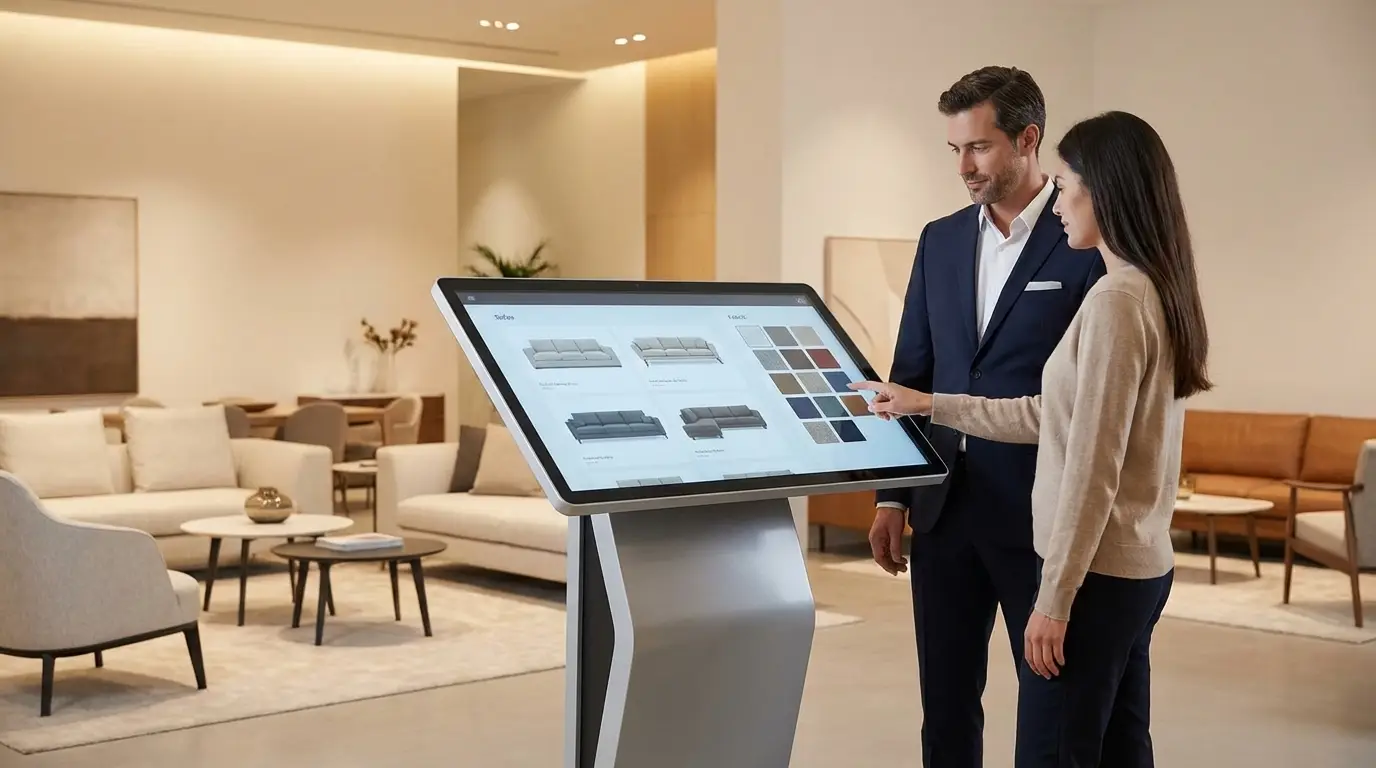
Independent furniture retailers lose sales every day, as their showroom cannot physically display every product. To be able to sell more, they historically always needed to expand. Until now. An endless aisle (or extended aisle) strategy, powered by digital catalogs and in-store kiosks and tablets, lets you sell your full catalog without a single extra square foot. And in the age of “agentic commerce”, showing up for more items can be the difference between being seen or staying invisible.
TL/DR
Floor space is finite. Your catalog does not have to be. Independent furniture and mattress retailers who adopt a digital catalog and endless aisle kiosk strategy consistently expand their effective assortment, reduce lost sales, and increase average order value – without taking on new square footage or inventory risk.
Table of Contents
- The Floor Space Problem
- What Is an Endless Aisle?
- Why a Digital Catalog Changes the Equation
- The In-Store Kiosk: A Salesperson Who Never Clocks Out
- Key Questions to Address Before You Deploy
- The Right Tool Makes the Difference
- Conclusion
The Floor Space Problem – Keeping You From Selling More
Walk into any independent furniture or mattress store and the tension is immediately visible: enormous products, limited floor space, and customers who seek options. The average independent showroom can physically display only a fraction of the SKUs a brand offers. When a shopper walks out because the right configuration, color, or price point was not on the floor, that is not a missed sale in the abstract – it is rather a sale your online competitor or a big-box chain picked up instead.
This is a structural problem. Showroom leases are expensive, furniture is large, and customers expect variety. A study by Retail TouchPoints found that 87% of retailers rank creating a seamless customer experience across all channels as their top omnichannel priority – yet independent retailers often lack the digital tools to even show their full assortment in one place, let alone sell from it.
The good news: You no longer need to choose between a larger lease and a limited selection. A digital catalog strategy, combined with an in-store endless aisle kiosk, closes that gap in a way that is both affordable and fast to deploy. This allows you to sell more, without having to add extra showroom space.
What Is an Endless Aisle?
An endless aisle is a sales strategy that allows in-store customers to browse, configure, and order products that are not physically on the showroom floor. Instead of being limited to what you can display, you sell from your brand partners’ full catalogs – complete with specifications, finish options, pricing, and imagery – through a digital interface at the point of sale.
For furniture and mattress retailers, this is particularly powerful. A sofa may come in 30 fabric options. A mattress brand might offer 8 comfort levels across 6 size variants. A dining table could be available in 4 finishes and 3 sizes. No showroom can display all of that. A digital catalog can.
According to STORIS, an endless aisle strategy allows retailers to “showcase a broader range of products than what they are physically capable of in their stores,” directly addressing the customer experience problem of limited selection. And unlike e-commerce, this happens in person, where your sales team can guide the conversation and close the sale.
And what is it not?
For many retailers, even larger ones, deploying an endless aisle simply meant to bring the website in-store. This seems like an easy and quick way to fix the problem; however, it’s counterproductive. Showing a guest that the trip to the store was a waste of their time and they could have easily just shopped from home is a surefire way to destroy future foot traffic.
A website is an absolutely critical piece and a firm requirement for any retailer, but it should not be used as an in-store tool. It actually has the opposite effect and pushes people out the door.
Why a Digital Catalog Changes the Equation & Helps You Sell More
A printed catalog or a binder of spec sheets is a reference document. A digital catalog is a selling tool. It surfaces the right products quickly, shows rich imagery, supports custom configurations, and lets a sales associate walk through options side by side with a customer on a screen. Also, paper can’t communicate real-time inventory.
The business case is clear:
- Expand assortment without inventory risk. Products in a digital catalog are fulfilled directly by the brand or processed as special orders. You are not stocking what you show digitally – cash stays in your pocket.
- Reduce lost sales. When a customer’s preferred configuration is not on the floor, you have an immediate answer. The sale stays in your store.
- Increase average order value. Digital tools surface upsell options, coordinating pieces, and accessories that a sales associate might not think to mention in a typical floor walk.
- Speed up the sales process. One Wonder retailer reported cutting their sales process time by 90% after deploying a digital catalog tool.
This advantage also compounds in unpredictable market conditions. Retailers dealing with supply chain volatility – a topic we have covered in depth in How Home Furnishings Retailers Adapt to Supply Chain Issues – find that digital catalogs provide a natural buffer. When floor samples are delayed or temporarily out of stock, your full assortment stays in front of customers without interruption.
The In-Store Kiosk: A Salesperson Who Never Clocks Out
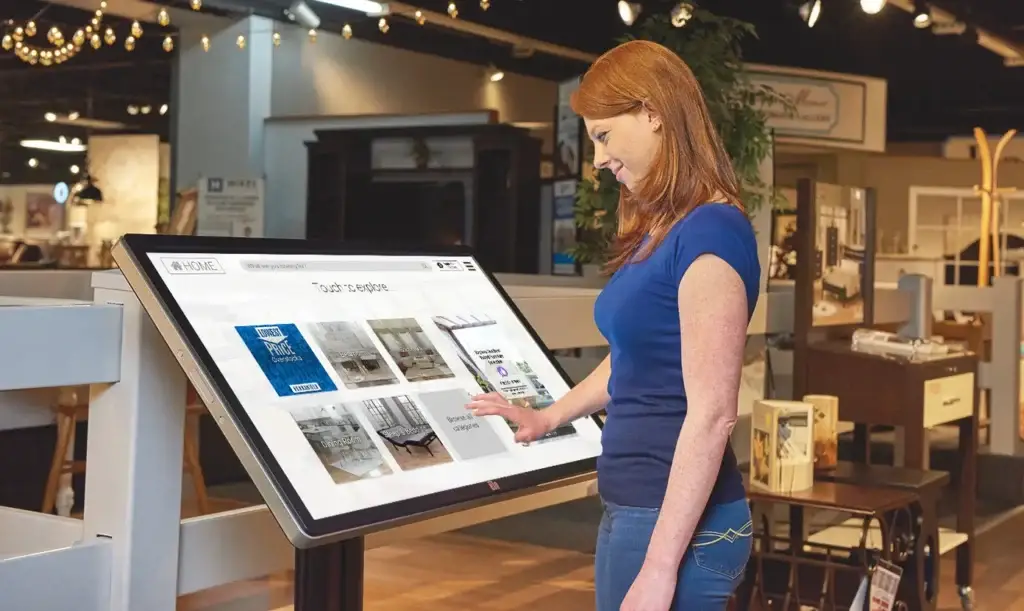
A self-service kiosk takes the digital catalog concept one step further. It puts the browsing experience directly in the customer’s hands, even when a sales associate is busy with another customer or the store is lightly staffed.
Think of an endless aisle kiosk as an associate who never calls in sick, always knows every SKU from every brand, and works without a commission. For independent retailers who watch every line item in their payroll budget, this is a meaningful operational advantage.
The kiosk also serves a function that is easy to underestimate: it gives browsers a productive task. Instead of waiting awkwardly for help, customers engage with products, explore options, and build desire. By the time an associate reaches them, they are further along in the decision process and more likely to convert.
This model fits naturally with the growing store-within-a-store format, where brands and retailers share physical space and digital tools anchor each brand’s presence. As we explored in our piece on embedded retail and store-within-a-store concepts, a digital kiosk anchors a brand’s presence on a retailer’s floor without requiring a full shop-in-shop buildout – lower cost, faster setup, and easier to update.
Key Questions to Address Before You Deploy
An endless aisle rollout is straightforward, but a few practical considerations will determine how well it performs in your store.
Product data quality. Your digital catalog is only as good as the data behind it. Work with brands and sales reps who can provide structured, current product data – images, dimensions, finish options, and pricing. Look for platforms that automate product data syndication directly from the manufacturer so your catalog stays current without manual effort.
Staff buy-in. A kiosk or digital catalog is a sales tool, not a self-service replacement for your team. Train floor associates to use it alongside the customer, rather than pointing customers to it and walking away. A brief onboarding session is usually enough to get your team comfortable.
Financing integration. The larger the average ticket, the more critical financing is at the point of sale. A digital catalog paired with a clear financing presentation can lift conversion meaningfully on high-ticket items. We cover the mechanics of this in detail in The #1 Key to Winning With Financing in Furniture Retail.
Omnichannel continuity. A customer who browses in-store and then wants to continue the research at home should be able to pick up where they left off. Look for solutions that support quote-saving, email follow-up, and a consistent product experience across touchpoints.
The Right Tool Makes the Difference
We built Wonder specifically for furniture, mattress, and home furnishings retailers. Its digital catalog platform and endless aisle kiosk connect independent retailers directly to brand product data – no outdated spec binders, no spreadsheet wrangling. Sales associates pull up any SKU from any connected brand in seconds, with current images, configurations, and pricing.
Independent retailers who have deployed Wonder describe the ROI in straightforward terms. One said it was “like adding a salesperson at a fraction of the cost.” Another reported that it paid for itself immediately. For a category with high average tickets and a relationship-driven sales process, that kind of efficiency gain compounds quickly.
If you are ready to expand your assortment without expanding your footprint, book a demo with Wonder to see how it works in a store like yours.
Conclusion: How To Sell More, Without Adding Square Footage
Floor space will always be a constraint in furniture retail. The retailers who grow and are able to sell more, are the ones who refuse to let that constraint define their assortment or their customer experience.
A digital catalog and endless aisle kiosk give independent furniture and mattress retailers a proven, low-risk path to showing more, selling more, and serving customers better – all without signing a bigger lease or taking on inventory risk. The technology is available, affordable, and proven across the industry.
The only real question is whether you deploy it before your competitors do.