A customer walks into your furniture store, spends 45 minutes with your sales associate, and leaves to “think about it.” In furniture retail, that walk-out often becomes a lost sale. The customer heads home, opens a browser, and orders from a big-box website instead.
Independent furniture retailers have every advantage needed to win that sale on the first visit. The showroom experience, personalized service, and product expertise that national chains and online giants cannot replicate are genuinely powerful. But those advantages only convert when your sales process, technology, and tools are tight.
Here are 7 proven tactics to help your team close more sales on the showroom floor.
1. Show Every Product, Even What’s Not on the Floor
The average furniture showroom displays a fraction of the products a brand actually offers. Square footage is expensive, and no retailer can stock every fabric, finish, or configuration. When a customer asks for a sofa in a color or size you don’t have on display, the instinctive answer is often “we can order that” — but that vague promise rarely closes a deal on the spot.
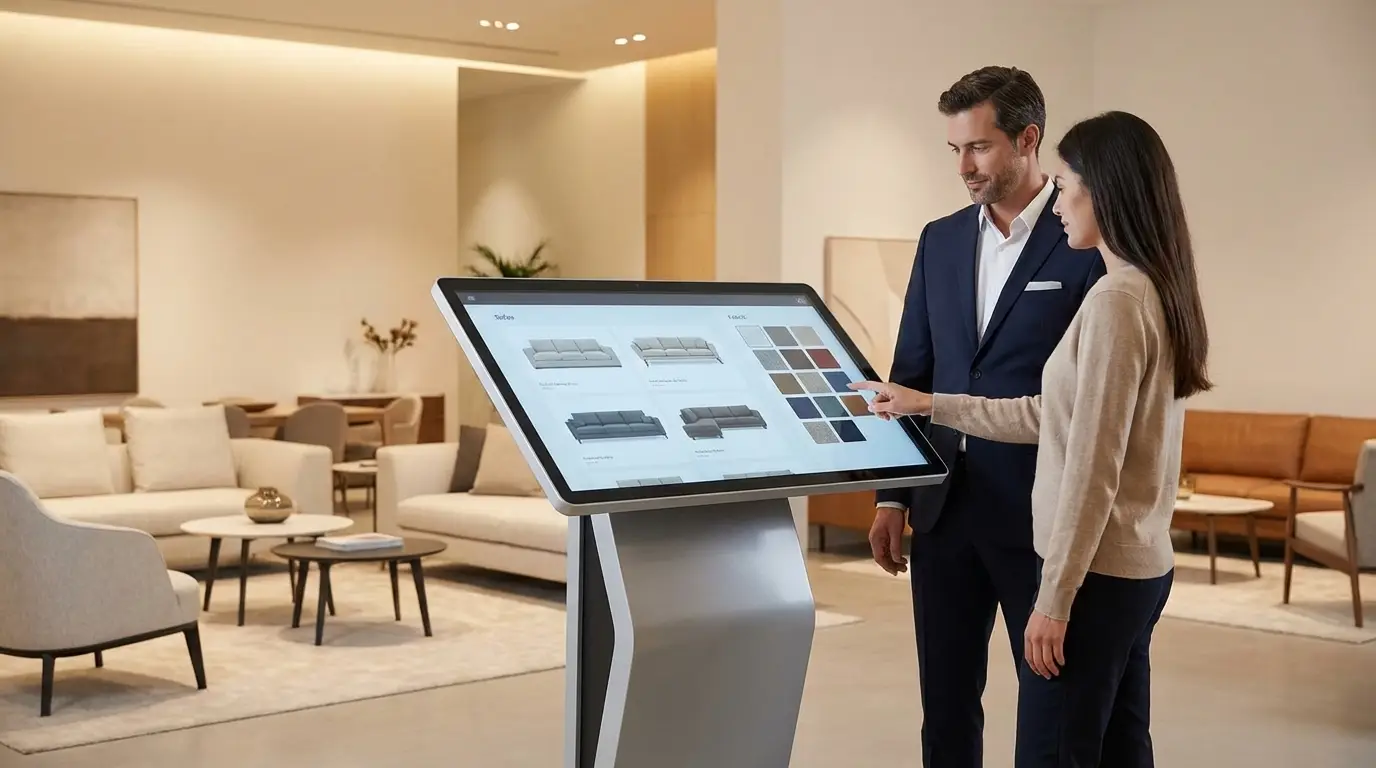
The solution is an endless-aisle strategy: a digital catalog or in-store kiosk that lets your sales team show the complete product lineup in real time, with full imagery, spec sheets, and customization options. Customers who can see exactly what they’re ordering commit at a much higher rate than those who rely on imagination alone.
For a deeper look at how this works in practice, read How Retailers Can Sell More Without Expanding.
2. Lead With Consultative Questions, Not Product Features
High-ticket purchases like furniture require trust before commitment. Sales associates who lead with “let me tell you about this sofa” lose customers quickly. Associates who lead with “tell me about the room you’re furnishing?” create a conversation.
The best furniture salespeople treat the first five minutes of any interaction as a discovery session. They ask about the customer’s lifestyle, existing decor, household size, and timeline. Every product recommendation that follows comes from that context, which means it feels personalized and relevant rather than transactional. This article in Furniture World contains some good questions to ask.
Train your team to listen 70% of the time in that opening window. The product pitch comes after the problem is fully understood.
3. Make Financing Visible Before the Customer Asks
Furniture is a significant purchase. Even a consumer who genuinely wants a $2,000 sofa can hesitate at the register if payment feels like a cliff rather than a step. Independent retailers who surface financing options early and often – before the customer is mentally anchored to a price point – remove that hesitation from the equation.

Displaying monthly payment options on the showroom floor alongside the sticker price reframes the decision. A sofa at “$89/month” reads differently than “$1,799.” Customers who see the monthly figure often increase their budget because the commitment feels manageable.
For a comprehensive breakdown of financing strategy in furniture retail, see The #1 Key to Winning With Financing in Furniture Retail.
4. Use Social Proof at the Point of Decision
Customer reviews and testimonials carry significant weight when a buyer is on the fence. A shopper who loves a sectional but hesitates on durability will often commit after hearing that 500 other customers gave it 4.8 stars.
Post QR codes near key pieces linking to product reviews. Train associates to share real customer stories during the consultation. If you carry a brand with strong review data, that context belongs in the sales conversation – not hidden on a product detail page the customer may never visit.
5. Create Real, Time-Bound Urgency
Urgency manufactured around a permanent “sale” loses credibility fast. Real urgency comes from three genuine sources: limited stock, a vendor promotion with an actual end date, and overstock deals where the pricing is visibly unusual.
Overstock events give independent retailers a powerful tool that customers associate with larger chains. Deep discounts on quality pieces, when they appear authentic and specific, drive same-day decisions at a rate that standard pricing simply cannot match.
Independent retailers also benefit from staying informed when supply chain disruptions affect lead times. When your vendor’s next shipment of a popular item is delayed by six weeks, that’s a legitimate and honest reason for a customer to buy today. See how retailers handle inventory uncertainty in Supply Chain Issues – How Home Furnishings Retailers Adapt.
6. Equip Your Sales Team With the Right Digital Tools
A sales associate who answers product questions from memory competes on a different level than one armed with a digital catalog on a tablet or an in-store kiosk. The difference shows up in the customer’s confidence at the point of purchase.
Wonder’s sales enablement platform gives furniture retailers and the brands they carry a shared digital infrastructure: up-to-date product data, rich imagery, and the full product assortment available at the touchpoint where the sale happens. When an associate can pull up the exact product configuration a customer wants in 30 seconds – rather than flipping through paper spec sheets or calling a brand rep – the transaction moves faster. Retailers using Wonder’s platform report reducing their sales process time by up to 90%.
7. Follow Up Within 24 Hours
Walk-ins who leave without buying rarely return on their own. A structured follow-up process within 24 hours recovers a significant portion of those near-closes. The follow-up needs to be personal – not a mass email blast – and it should reference the specific pieces the customer showed interest in.
A simple text message or personal call that says “I pulled up the sectional we discussed in the fabric you liked, here’s a link to the spec sheet” shows attentiveness and keeps your store top of mind before the customer finalizes their decision elsewhere.
Pair the follow-up with a limited-time offer when you have one, and your conversion rate on walk-outs will climb. Also, make sure your text messages are transactional. Nothing worse than trying to buy and having to jump through hoops to do so.
The Bottom Line
Independent furniture retailers win on the floor when their sales team combines genuine expertise with the right digital tools and a consultative approach. Each of these seven tactics compounds: better product visibility leads to more trust, better trust leads to more financing conversations, and more financing conversations lead to more same-day closes.
Did you know that Wonder customers have access to a Financing Waterfall platform – at NO COST?
If you’re ready to put the right tools behind your showroom team: Book a demo with Wonder and see what a complete digital catalog and sales enablement platform looks like for independent retailers.