
Fewer customers walking through the door. That was the problem Michael Faber, President of Royal Furniture Co, was staring at. In this Royal Furniture Wonder App case study, his team faced the same challenge a lot of independent retailers feel right now.
The answer was not more traffic. Instead, it was better conversations on the floor.
Across 26 stores, Royal put Wonder App in associates’ hands for product training and sales incentives. As a result, completed sales averaged about $300 more, with an 11% lift in average order value, when Faber had been hoping for maybe 3 or 4%.
Watch the story:
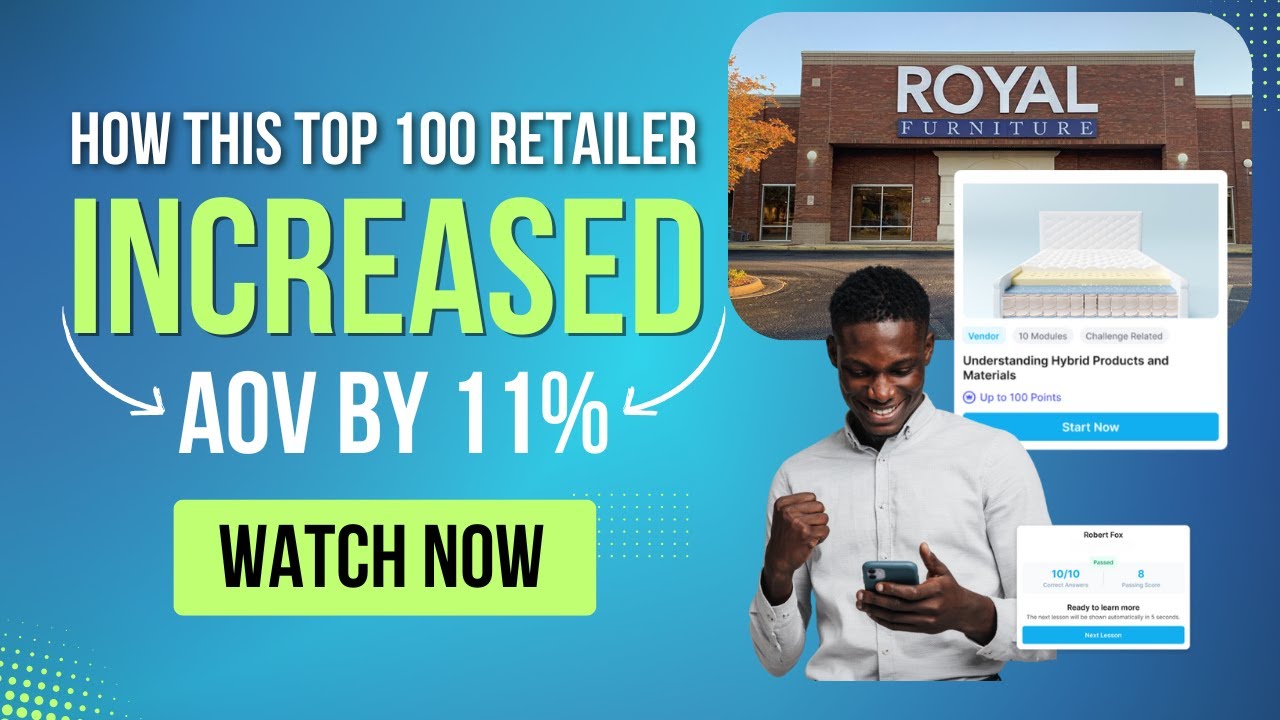
When traffic is soft, every shopper has to count.
That means knowing why one mattress is worth another $200. It means catching the feature that never made it into the sales meeting email. It means an associate who can answer in the moment, before a call to the rep.
At Royal, training the old way meant getting product into the store and running meetings across 26 locations. Vendor material often arrived as email. Even tenured people missed things.
One dresser had been on the floor for a while. Nobody knew it had a hidden drawer.
“I know that sounds crazy,” the team said on camera. It is not. Because product knowledge lived in a binder or an inbox, not on the phone in someone’s pocket.
Royal did not want another mandatory click-through in the back room.
With Wonder App, associates review short modules, take a quiz, and earn points. Those points turn into gift cards. Faber’s team has always preferred the carrot.
Participation told the story: almost 100% of associates got in.
Meanwhile, a little something extra on the floor changes what people prioritize. When there is an incentive tied to what you are promoting that week, you lead with it.
Associates described it in plain terms: more drive to finish the training, more money for the salesperson, and knowledge they could pull up without hunting down a manager or a manufacturer rep.
“It is almost like having access to our manufacturer reps,” one leader put it. Questions that used to mean a phone call get answered on the phone, “nine out of ten times.”
Short modules. Leisure time. Real retention. In other words, knowledge is there when a guest walks up.
For example, a suite had one hidden spot everyone knew about. The app surfaced another. That detail became one more thing to show the customer: “just one more bullet to help you close the sale.”
Another associate was selling a mattress. The customer wanted a mattress and a box spring. They did not want the adjustable base. Training from the app gave features and benefits, including zero gravity, and the associate closed the sale with the base included.
That is the job: educated shoppers buy more of the right thing.
Faber was blunt about expectations.
“I was thinking 3 to 4% maybe and we got 11.”
Michael Faber, President, Royal Furniture Co
In both newer stores and legacy stores, completed sales averaged about $300 more per interaction. He said he was pleasantly surprised. After that, Royal kept using Wonder App.
Those are the numbers we will stand behind from the case study video. Nothing from confidential pilot decks. Nothing invented.
Technology is easy to overspend on. Faber’s bar was simple: the lift has to be worth the time and money.
For Royal Furniture, Wonder App cleared that bar, with training people actually finish, incentives that change behavior, and product knowledge that shows up when the guest is standing there.
Likewise, the full conversation with Michael Faber and the Royal team is on YouTube.
Finally, see how Wonder App works for multi-location furniture retailers. Contact Wonder to talk it through. Learn more about Wonder for retailers and frontline sales enablement.
